Learnings from Covid: Building a resilient Cambridge
Learnings from Covid: Building a resilient Cambridge
By Sam Dyer MBE, CEO, Cambridge Sustainable Food
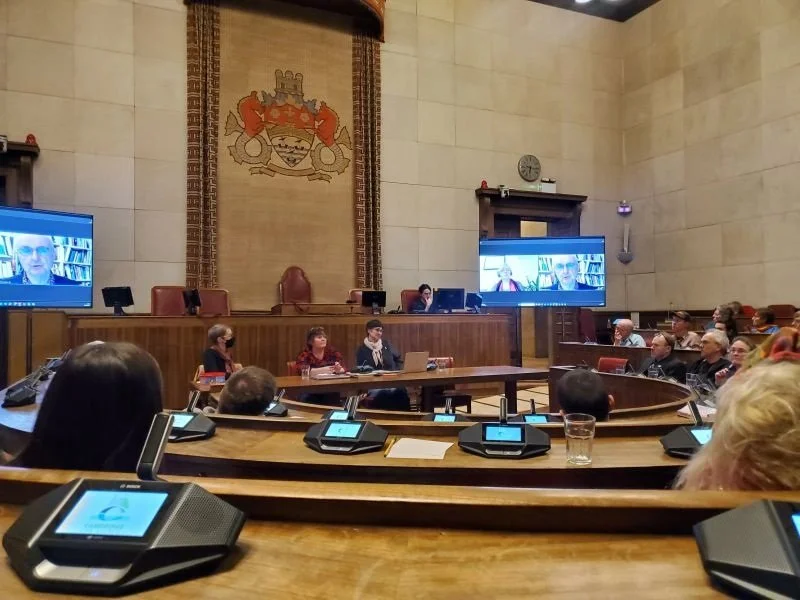
It was a privilege recently to share a platform with Tim Lang, Professor of Food Policy at City, University of London's Centre for Food Policy, Kath Delmeny CEO Sustain and Councillor Katie Thornburrow reflecting on food resilience in the UK and Cambridge.
Tim Lang talked us through his report Just in Case: narrowing the UK civil food resilience gap, produced for the National Preparedness Commission. The report is a stark reminder that at a national level, food resilience is only narrowly understood. The 2023 National Risk Register identifies only one direct food-related risk: food supply contamination. What it largely overlooks is how quickly shocks such as pandemics, climate events or economic disruption translate into loss of access to food for households, long before supply itself fails. Lang’s work challenges us to broaden our understanding of food resilience to include civil society, local systems and the everyday infrastructures people rely on to eat well.
In my presentation I reflected on what we learned from the emergency food response in Cambridge during Covid, and what those lessons tell us about the need for better preparedness.
Nationally, the pandemic exposed deep fragilities in our food system. Locally, in Cambridge, it also showed what is possible when communities, councils and civil society are trusted to act and work together. Covid did not create food insecurity. It exposed it, and tested whether local food systems could respond at speed and at scale when people suddenly lost income, access and stability.
Cambridge is often described as prosperous and resilient. But the pandemic made clear that beneath that narrative sits high housing costs, insecure work, health inequalities and households living close to the edge. When Covid hit, demand for food support rose sharply and has not returned to pre-pandemic levels.
What matters now is not just what happened during the crisis, but what we learned from it and what we can do to build resilience into our food system at a community level.
Civil food resilience in practice
Tim Lang describes civil food resilience as the capacity of people in their daily lives to be more aware of risks to food, more skilled in reducing unnecessary risks, and more prepared to act with others to ensure all society is well fed in and after crises.
In Cambridge, resilience was not about stockpiles or self sufficiency. It was about relationships, coordination and trust.
Before the pandemic, Cambridge already had a Sustainable Food Partnership, a Food Poverty Alliance, holiday lunch providers, food banks, growers, community kitchens and councils working together. Those relationships meant we did not start from scratch when lockdown began.
These relationships also allowed the Food Poverty Alliance and others to meet within a few days of lockdown being declared. Information was shared. Decisions were made quickly. Speed mattered. In a crisis, days count.
Distributed systems proved stronger than centralised ones
One of the clearest lessons from Covid was that distributed, place-based systems are more resilient than single, centralised models.
Cambridge’s response worked because it was rooted in neighbourhoods:
eight community food hubs across the city
Mutual Aid groups in each ward were seed funded by the City Council
multiple foodbank welcome centres adapting their delivery models
holiday lunches shifting between doorstep deliveries, outdoor events and shared meals
community kitchens and meal providers flexing formats as guidance changed
What can look like duplication in normal times becomes strength in a crisis. Redundancy is not a waste. It can look like resilience.
Skills were as important as food
A less discussed but crucial learning was the role of people’s skills.
During Covid, people from all sectors were furloughed. Hospitality workers, university staff, self-employed contractors, project managers, data analysts, academics, chefs and drivers suddenly had time and a desire to help.
That extraordinary range of skills flowed into the voluntary sector response. Logistics expertise helped manage surplus food. Catering skills and trained chefs enabled large-scale cooking and Community organisers helped reach people quickly and safely.
Food resilience planning often focuses on food supply. Covid showed us that skills mobilisation is just as important. Future resilience depends on having places where people can plug in quickly and be supported to contribute.
Information became critical infrastructure
Another key lesson was the importance of clear, shared information. Often those most vulnerable wanted reassurance and clear information. Some of the places they were able to get this information were food access points.
During the pandemic, Cambridge expanded its food support signposting so that frontline workers, councils, community groups and residents could see what was available, where and how to access it. Food Standards Agency changing advice was communicated to hubs.
Good information reduced duplication, eased pressure on individual services and helped people get support faster. Information is not a nice-to-have. It is infrastructure.
From emergency food to dignity and prevention
What began as a crisis response had become a long-term reality for many households. The cost of living crisis followed, and it is clear that emergency models cannot be the end point. Cambridge therefore began shifting from:
emergency food hubs to social supermarkets
short-term parcels to choice-based models
crisis response to longer-term affordable food access and advice at the point of access.
This evolution matters for resilience. Systems that only respond to crisis entrench it. Resilient food systems reduce the number of people who need emergency help in the first place and do so in ways that preserve dignity and agency.
Climate-friendly food strengthened resilience
A final learning is worth stating clearly. Climate-friendly food made the response stronger, not weaker.
Plant-based meals, surplus redistribution and locally grown food proved cheaper, easier to scale and less vulnerable to supply shocks. Cooking from scratch with seasonal ingredients was more adaptable than relying on highly processed supply chains. Local farmers, growers, allotment holders all grew and donated produce.
Climate action and food resilience are not competing agendas.
What this means for local policy
If we take these lessons seriously, there are clear implications for local policy.
Food must be treated as essential infrastructure, not a discretionary add-on. This means embedding food into emergency planning, climate strategies, public health and spatial planning.
We need to invest in distributed community food infrastructure. Community kitchens, social supermarkets, growing spaces and neighbourhood hubs are resilience assets.
We need sustained funding for coordination and capacity, not just crisis delivery.
Planning policy should protect and enable space for food. Growing, cooking, storing and sharing food all require physical infrastructure that needs to be designed in, not retrofitted.
Food resilience must be preventative. That means supporting affordable food access, income security, advice services and dignified food models that reduce the need for emergency support.
Looking ahead
Covid showed what is possible when communities are trusted and local systems are enabled to act. The risk now is not that we forget the details, but that we quietly revert to seeing food as someone else’s problem.
The next shock may not look like a pandemic. It could be climate, energy, trade or economic. But it will test the same things: speed, coordination, trust and whether good food is recognised as a public right.
Cambridge has learned a great deal. The question is whether we choose to build on it.
Tim Lang recommends the following steps:
Practical steps local authorities and civil society can take to build food resilience
1. Treat food as essential infrastructure
Embed food access explicitly into emergency planning, climate adaptation, public health and local plans. Food should sit alongside energy, housing and transport in risk planning.
2. Map food assets and vulnerabilities
Maintain a live map of local food infrastructure: food hubs, food banks, community kitchens, social supermarkets, growers, storage space, volunteers and skills. Know where the gaps are before a crisis hits.
3. Create a standing food resilience forum
Bring councils, emergency planners, health partners and civil society together regularly, not just in emergencies. Use this space to plan, test and update responses.
4. Plan for ‘just in case’, not just ‘just in time’
Build redundancy into food systems. Support multiple supply routes, local producers, backup venues and flexible procurement rather than relying on single, lean supply chains.
5. Invest in community food infrastructure
Community kitchens, social supermarkets, food hubs and growing spaces are resilience assets. They should be funded as preventative infrastructure, not short-term crisis responses.
6. Formalise the role of civil society
Voluntary and community organisations should be recognised as delivery partners in resilience planning, with clear roles, data-sharing and sustainable funding.
7. Prioritise information and coordination
Clear, shared signposting and data systems reduce pressure on services and help people access support quickly. Information is critical infrastructure in a crisis.
8. Test and review plans together
Run local food shock scenarios and tabletop exercises with councils and community partners. Review what works, fix gaps and keep plans up to date.
Covid showed that communities can respond fast when trusted and supported. The National Preparedness Commission is clear that the next step is to move from improvisation to preparedness. Building food resilience locally is not about stockpiling food. It is about relationships, coordination and investment in the systems people already rely on.